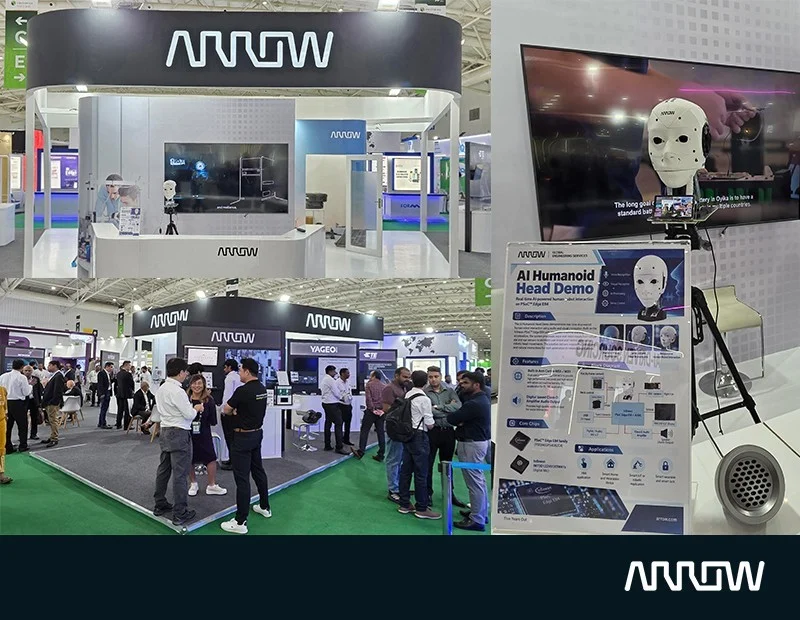

Arrow Electronics will put intelligent and sustainable technology at the centre of its presence at electronica India 2026, with the global technology solutions provider telling customers it can help them accelerate innovation across industrial automation, energy, mobility and AI applications. Visitors will find the company at Hall 5, Booth E31 at the Bangalore International Exhibition Centre (BIEC) [Arrow Electronics Newsroom].
The pitch lands in a market that is scaling fast. India's electronics manufacturing industry is projected to reach USD 500 billion by 2030, according to the India Brand Equity Foundation, a trajectory that is pulling unprecedented demand for advanced components, design services and engineering support [India Brand Equity Foundation].
Why electronica India Matters to the Global Supply Chain
electronica India is the country's largest trade fair for electronic components, systems and applications, and it has become a fixture on the calendar for distributors, design houses and original equipment manufacturers alike [electronica India]. The Bangalore International Exhibition Centre hosts the event, placing it at the heart of one of Asia's densest electronics and embedded engineering clusters [BIEC].
That geography is not incidental. Bengaluru is home to a deep bench of automotive, aerospace, industrial and semiconductor talent, and it sits at the centre of India's ambitions in chip design and electronics system design and manufacturing. For a distributor-cum-solutions-provider like Arrow, the show is less a product catalogue and more a customer acquisition funnel.
What Arrow Is Actually Showing
Arrow's four declared focus areas map cleanly onto where Indian capital expenditure is heading. Industrial automation covers factory-floor sensing, motor control, robotics and edge compute — segments where component selection, thermal design and functional safety all determine time-to-market. Energy spans power conversion, battery management, solar inverters and grid-edge intelligence, the engineering backbone of India's renewable build-out.
Mobility covers electric drivetrains, charging infrastructure and in-vehicle electronics, while the AI applications track addresses the inference silicon, edge accelerators and development platforms that let engineers run models where the data is generated rather than in a distant data centre. Arrow presents these as a single integrated offer rather than four disconnected verticals [Arrow Electronics].
The "sustainable" half of the message is doing real commercial work. Designers are under pressure from customers and regulators to demonstrate lower embodied carbon, better energy efficiency and responsible sourcing. A distributor that can supply both the part and the documentation trail has a meaningful advantage over one that simply moves boxes.
Analysis: Distribution Is Becoming Engineering Services
The strategic subtext here is the steady migration of distribution into design services. Component distribution is a low-margin, high-volume business. Reference designs, proof-of-concept engineering, firmware support and supply chain resilience planning are higher-margin and far stickier. Events like electronica India are where that transformation is marketed.
Arrow's scale reinforces the point. As a global provider operating across components, enterprise computing and supply chain services, the company can use a regional showcase to upsell capabilities that a local competitor cannot match — particularly when it comes to sourcing assurance. After several years of allocation crunches and lead-time volatility, buyers increasingly treat supply chain visibility as a product feature in its own right [Arrow Electronics Products].
There is also an ecosystem argument. Trade fairs now function as matchmaking infrastructure, connecting chip vendors, module makers, design houses and end customers in the same hall. For India's growing pool of startups and small design firms, the ability to walk a booth like E31 and leave with a reference design, a sample kit and a supply chain contact compresses months of vendor scouting into a day.
Multiple Perspectives
The supplier view: For Arrow, India is a growth market with a widening engineering base. The company's messaging emphasises acceleration — the idea that the bottleneck is not ideas but the time and risk required to industrialise them.
The local engineering view: Indian design services firms argue that global distributors must do more than bring catalogues. What mid-sized product companies need is hands-on help with compliance, EMI/EMC certification and manufacturability, especially as India's own standards regime matures.
The policy view: Government incentive programmes for electronics manufacturing have changed the calculus for local production, and the IBEF's USD 500 billion projection for 2030 assumes those schemes keep converting into actual capacity [IBEF]. Trade shows are one of the few places where policy ambition, component supply and customer demand are visible in the same room.
"India's electronics manufacturing industry is projected to reach USD 500 billion by 2030, fueling demand for advanced technologies that help accelerate innovation across industrial automation, energy, mobility and AI applications." — Arrow Electronics, event announcement
What Happens Next
Expect the follow-through to be measurable rather than theatrical. In the weeks after the show, the tell-tale signs of a successful exhibition are design registrations, sample requests and distributor appointments — not press coverage. If Arrow's four verticals convert into named customer programmes, that will matter more than any booth demo.
Watch three signals. First, whether Arrow deepens local inventory and engineering headcount in India, which would signal genuine commitment over event marketing. Second, whether its AI application demos ship as production-ready reference platforms rather than one-off proofs of concept. Third, whether the sustainability angle hardens into auditable data — carbon accounting, traceability and end-of-life documentation — or remains a slogan.
The broader trend is harder to reverse. As India's electronics ecosystem matures, the value in the channel shifts from availability toward expertise. Companies that only compete on stock will face margin compression; companies that compete on design-in support will own the customer relationship for a product's entire life cycle.
Editorial Perspective
Arrow's electronica India 2026 showcase is a modest announcement with an immodest implication: the component distributor is quietly repositioning as an engineering partner, and India is the proving ground. The country's projected run toward USD 500 billion in electronics manufacturing by 2030 gives that repositioning a credible tailwind, but credibility ultimately rests on execution.
Booth E31 at Hall 5 will be judged on what walks out of it — engineers with reference designs, procurement teams with sourcing plans, and startups with a faster route to a manufacturable product. That is the metric that matters, and it is the one this exhibition season will quietly be scored against.